Worldwide, carers of people with dementia should have access to information and support tailored to their needs in order to effectively respond to, and manage, the physical, mental and social demands associated with caring for someone living with dementia. iSupport has been developed to provide accessible, evidence-based training and information, tailored to carers’ needs. It aims to improve knowledge and caregiving skills, such as carers’ ability to cope with dementia symptoms and care for themselves. iSupport seeks to enable people with dementia to live in the community while preventing or reducing carer stress. The lessons included in this manual were carefully designed to help carers tackle the important challenges that they may face when caring for someone living with dementia.
What is included in the iSupport manual?
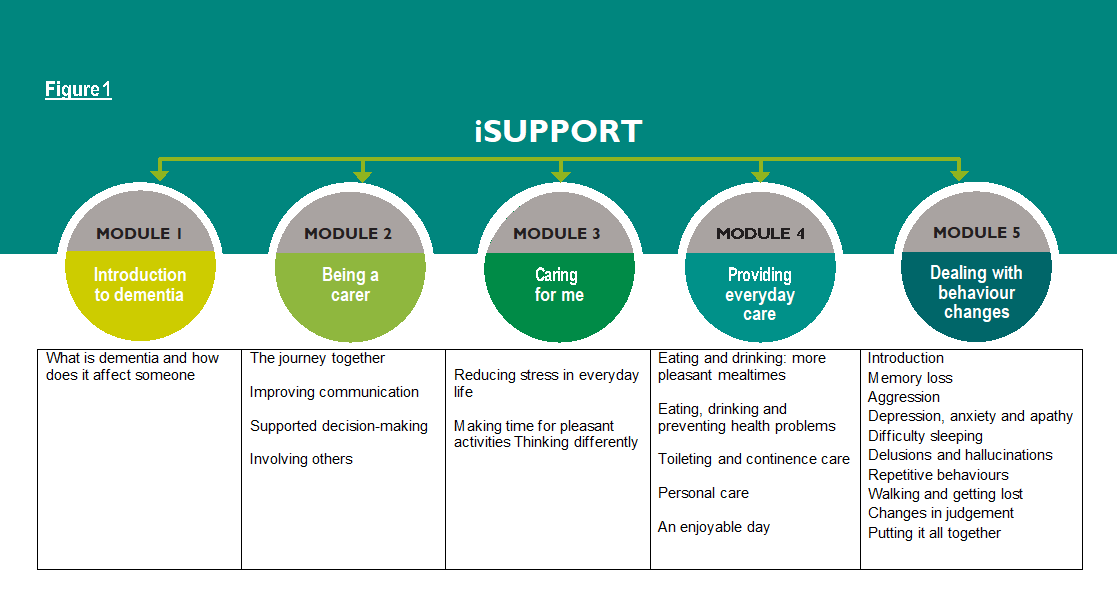
The manual is organized into five modules
-
Introduction to dementia
-
Being a carer
-
Caring for me
-
Providing everyday care
-
Dealing with behaviour changes that might happen in people living with dementia.
Module 1 provides an introduction to what dementia is, including what happens to people with dementia and what to do if you think that your family member or friend has dementia.
Module 2 focuses on improving communication, shared decision-making and involving others in caring for the person living with dementia.
Module 3 aims to reduce carer stress by making time for pleasant activities and thinking differently.
Module 4 focuses on eating and drinking, including creating more pleasant mealtimes and preventing health problems, using the toilet and continence care, and personal care.
Module 5 provides an introduction to common changes in behaviour for people with dementia that might be distressing and upsetting for both the person with dementia and you as the carer. These symptoms include memory loss, aggression, depression and anxiety, difficulty sleeping, delusion and hallucinations, repetitive behaviour, walking and getting lost as well as poor or decreased judgement.
Who is the target audience?
This iSupport manual is primarily for carers of people with dementia, including family members and relatives, friends, and other carers.
However, iSupport may also be of interest to others, for example:
- nongovernmental organizations (NGOs) providing skills training, support and/or information to carers of people with dementia;
- health and social care workers providing care and information to carers of people with dementia; and
-
private sector representatives involved in the development of health technologies for dementia, dementia health care service delivery or health care insurance.
How was iSupport developed?
iSupport is grounded in WHO’s Mental Health Gap Action Programme (mhGAP) guidelines for carers of people with dementia. mhGAP aims to scale health and social care services for mental, neurological and substance use disorders for all countries, with a focus on low- and middle-income countries (LMICs). iSupport was developed based on evidence related to the feasibility and effectiveness of carer training and support interventions, both in person and online. Finally, the programme was developed in collaboration with international experts in the field of caregiving for people with dementia and internet-based interventions, and reflects the voices of carers of people with dementia. For more information on the development of iSupport see Pot et al (2019)1.
How to use this iSupport manual?
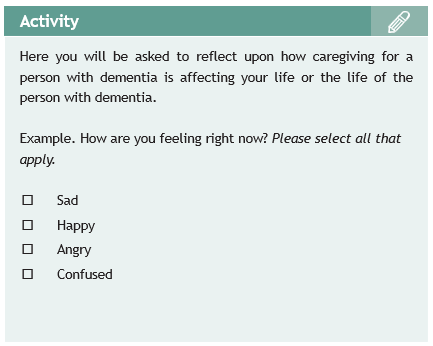
iSupport has been developed as a self-help tool for carers of people living with dementia. Each module is divided into individual lessons (see Figure 1). All lessons are structured in the same way. At the beginning, there is an overview of why the lesson is important, how the lesson will help you as a carer and what you will learn. Each lesson then consists of a mixture of brief reading to provide new information, descriptive examples, multiple choice questions and activities to practice what you have learned. You may choose to work through the entire manual from beginning to end or select the lessons that are most relevant to your everyday life. You can also come back to individual lessons.
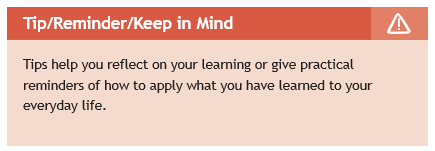
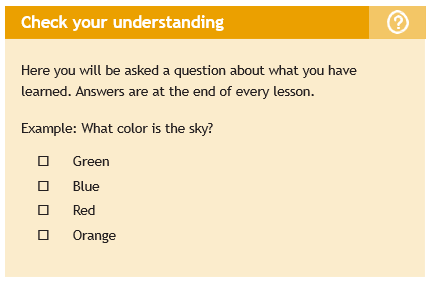
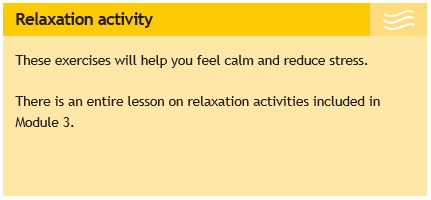
Below is a guide to the individual exercises and activities that you will encounter throughout the manual. These exercises and activities allow for you to check your understanding and reflect on your learning in practical ways.
Other uses of iSupportAlthough iSupport is primarily a self-help tool, we encourage a broader use. For example, iSupport might be supplemented by guidance from volunteers or health care workers to create more impact. The iSupport manual can also serve as a tool to structure educational or support group meetings for carers of people with dementia, or it may simply be used as a resource tool for participants of self-help groups. Finally, health care workers might find iSupport useful in assisting and supporting carers.
Please note that both the iSupport online training programme and this manual are subject to ongoing rigorous field-testing and evaluation. More research is needed to evaluate the effectiveness of local adaptions and implementations.
How to adapt iSupport?
The iSupport manual represents a template that can be adapted to national or local contexts and needs. An adaptation and implementation guide is available to assist countries/communities in this process.
WHO owns the copyright on iSupport. If you are interested in adapting and implementing iSupport, please contact WHO at whodementia@who.int to request a copyright license.
This applies to both the iSupport manual and the online programme, accessible at www.iSupportForDementia.org.
This content is based on the iSupport material from ©World Health Organization 2019 [ISBN 978-92-4-151586-3].
The iSupport Qatar version, an adaptation for Arabic speaking carers, is prepared by the Qatar National Dementia Plan (QNDP) team, with permission from the WHO.